
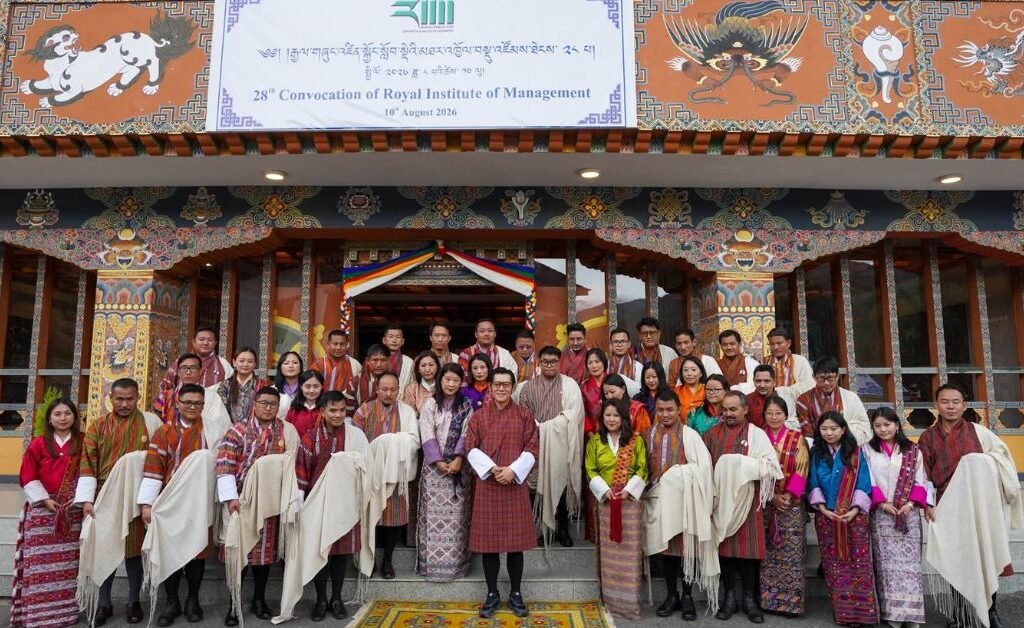
I recently had the honour of being granted a Royal Audience with His Majesty The King. I have been pondering on these points ever since.
His Majesty spoke about many things, but these are the three ideas that stayed with me the most. I have shared them here based on my own understanding and what I can remember from the Royal Audience. They may not capture His Majesty’s exact words, but I hope these reflections are useful to others as they have been to me.
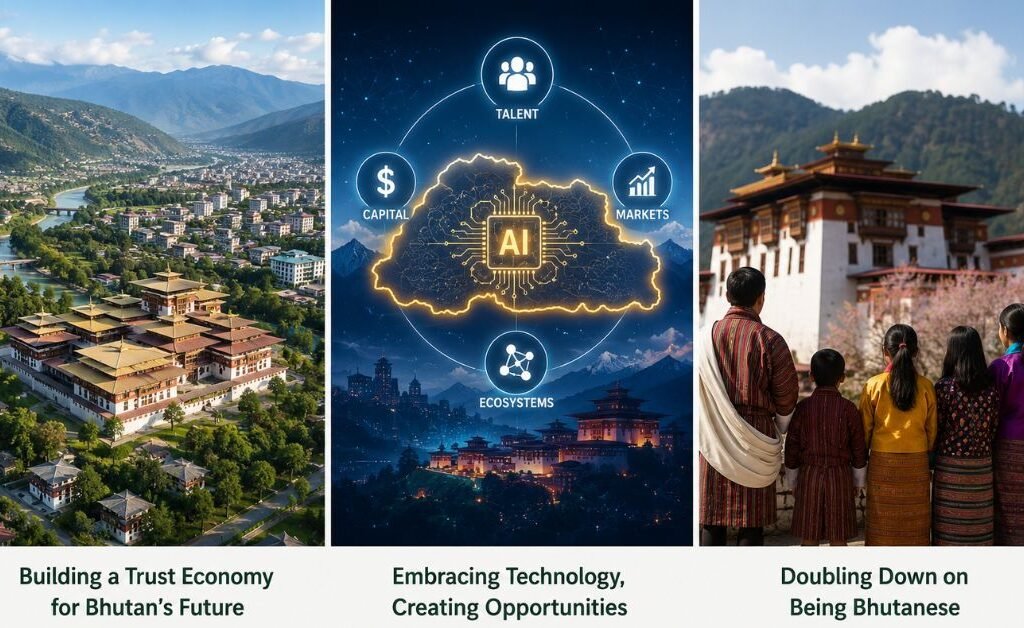
Building a Trust Economy
The first idea was the importance of building a Trust Economy, particularly in the context of Gelephu Mindfulness City (GMC).
His Majesty spoke about GMC as a part of a much longer national trajectory, a place that must be safe, that must be trusted, and that must remain grounded in our values even as it opens itself further to the world. GMC is envisioned as a space where innovation, values, and development sit together, and from which Bhutan can engage with the world meaningfully and confidently.
This wisdom changed how I think about the work ahead. The difficult part is not attracting global participation. The difficult part is welcoming the world in while ensuring that trust remains the foundation of everything we build.
Trust is slow to earn and quick to lose. Once it is gone, no amount of capital or infrastructure will bring it back. This is why it has to be the starting point rather than an afterthought.
Preparing for the age of artificial intelligence
The second idea was about technology, and artificial intelligence in particular.
His Majesty was direct about this. The coming decade will be transformative, and AI is likely to have an impact comparable to that of the internet. The guidance was not to approach it with hesitation, but with readiness and intent to understand it deeply, and to use it to strengthen our own capabilities and expand our own opportunities.
His Majesty also shared what makes global innovation ecosystems, such as Silicon Valley, actually work. It is not capital alone. It is the combination of several things at the same time such as talent, infrastructure, markets, and networks. Capital tends to follow that convergence rather than create it.
Bhutan cannot compete on any of those dimensions at scale. We do not have the population, the capital, or the infrastructure, and we should not exhaust ourselves pretending otherwise. What we can do is complement what we lack by engaging seriously with global talent and ecosystems, particularly from the neighbouring countries like India and Singapore.
The ambition, as I understood it, is not simply to adopt technology. It is to use technology to create new opportunities, to build outward-looking solutions, and to contribute to the much larger national aspiration of economic transformation. It is one thing to believe that AI matters. It is another to hear that urgency expressed at the highest level, and to realise how short ten years actually is.
Doubling down on being Bhutanese
The third idea is the most important one for me.
His Majesty’s message was clear. Our strength lies in what is uniquely ours. Our values, our ethics, our culture, and the trust already embedded in our society. They are potential sources of competitive advantage.
There are areas where Bhutan has something genuine to offer, such as ethical and responsible AI. We can demonstrate what it looks like when technology is developed in harmony with society, culture, and the environment, rather than at their expense. Very few countries are positioned to make that argument credibly. We are.
And as the world changes at speed, our identity, our culture, our traditions, and our values will become more relevant. In a world defined by scale and acceleration, a deeply rooted sense of identity and a society built on trust are rare things, and rare things hold their value.
We may never have the largest economy or the most advanced infrastructure. But we have something that cannot be copied, bought, or replicated: who we are as Bhutanese.
The message was to engage with it confidently, to learn, to adapt, and to compete while remaining firmly grounded in our identity.
What I took away
I was inspired but also felt the heavier sense of responsibility after the Royal Address. What stood out most was the clarity of the vision: a nation that is globally connected and deeply rooted at the same time.
Trust as our foundation. Technology as our instrument. Identity as our advantage.
There is a great deal of work ahead. There is also more opportunity in front of us than at any point I can remember. We must embrace the future, harness technology, and think bigger than we have been used to thinking, while holding firmly to what makes us Bhutanese.
Perhaps our greatest strength will not be in how closely we mirror the world, but in how confidently we define our own place within it.
Share